


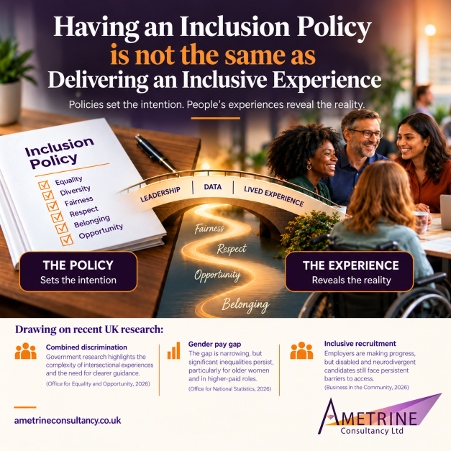
Most organisations today have an equality, diversity and inclusion (EDI) policy. Many have invested in training, published commitments to fairness and respect, and made public statements about the importance of creating an inclusive workplace.
But here’s the question I believe every organisation should be asking:
Does having an inclusion policy actually mean that people feel included?
The answer, unfortunately, is not always.
There is a significant difference between an organisation’s stated commitment to inclusion and the experiences of the people who work within it.
A policy can tell us what an organisation intends to do. It cannot, on its own, tell us what people experience every day.
And that distinction matters.
The gap between intention and experience
An organisation might have a beautifully written inclusion policy, clear equality objectives and a comprehensive training programme.
Yet employees may still experience exclusion, discrimination, microaggressions, unequal opportunities or a workplace culture in which they feel unable to speak openly.
Others may feel that their contributions are undervalued, their differences are misunderstood or that progression opportunities are not equally accessible.
The presence of a policy does not guarantee the presence of an inclusive culture.
Inclusion is not simply about what organisations say they believe. It is about how those beliefs are translated into decisions, behaviours, systems and everyday interactions.
It is about what happens when nobody is checking whether the policy is being followed.
What recent UK research tells us
Three recent pieces of UK research reinforce why organisations must look beyond policy commitments and examine the experiences of the people affected by them.
1. Combined discrimination: understanding the complexity of lived experience
Research published by the Office for Equality and Opportunity in October 2026 explores the experiences of people facing combined discrimination.
The research suggests that between 12% and 16% of discrimination claims and complaints feature more than one protected characteristic, while between 2% and 6% involve combined discrimination.
This highlights an important challenge for organisations.
People do not experience their identities in isolation.
An older Black woman, for example, may experience workplace barriers differently from a younger Black man or an older White woman. Their experiences cannot always be understood by examining race, age or sex independently.
Yet organisational policies and processes sometimes address protected characteristics in separate categories, overlooking how different aspects of identity can interact.
The lesson for organisations: Inclusion strategies must recognise the complexity of people’s experiences rather than assuming that a single approach will work for everyone.
2. The gender pay gap: progress does not mean equality has been achieved
The Office for National Statistics reported in October 2026 that the gender pay gap for full-time employees had decreased to 6.8% in April 2026, compared with 7.2% in April 2025.
This represents continued progress.
However, the research also shows that the gap remains greater among higher-paid employees and those aged 40 and over.
These findings raise important questions about progression, opportunity and how workplace structures affect different groups.
An organisation may have policies promoting equal opportunity, but what happens in practice?
Who is encouraged to apply for promotion? Who receives development opportunities? Whose potential is recognised? And whose career progression is affected by assumptions about caring responsibilities or flexible working?
The lesson for organisations: Having an equality policy is not enough. Organisations need to examine their workforce data, understand disparities and take meaningful action to address them.
3. Inclusive recruitment: opening the door is only the beginning
Business in the Community’s Opening Doors Progress Report 2026 identifies progress by employers in making recruitment more inclusive.
However, the report also highlights continuing barriers for disabled and neurodivergent candidates, including challenges around accessible recruitment processes.
This is a powerful reminder that an organisation can have an inclusive recruitment policy while still operating processes that unintentionally exclude talented people.
For example, a commitment to recruiting diverse talent means little if application systems are inaccessible, interview arrangements are inflexible or reasonable adjustments are difficult to obtain.
And recruitment is only the beginning.
Once someone joins an organisation, do they experience the same sense of inclusion that was promised during the recruitment process?
The lesson for organisations: Inclusion must be experienced throughout the employee journey, from recruitment and induction to development, progression and retention.
Moving from policy to practice
So how can organisations begin to close the gap between what they say and what people experience?
I believe there are five important areas of focus.
1. Listen to lived experiences
Employee surveys, listening exercises, cultural audits and meaningful conversations can provide valuable insights into what is happening beneath the surface.
But organisations must be prepared to hear uncomfortable truths and, importantly, act on what they discover.
2. Inclusive leadership is not simply about attending training or expressing support for EDI.
It requires leaders to demonstrate inclusive behaviours, challenge unfairness, make equitable decisions and take responsibility for the culture they create.
People watch what leaders do far more closely than they listen to what leaders say.
3. Use data to challenge assumptions
Workforce data can help organisations identify patterns that might otherwise remain hidden.
Recruitment outcomes, promotion rates, retention, pay gaps, employee relations cases and engagement results can all reveal where experiences and opportunities differ.
However, data alone is insufficient. It must be considered alongside people’s experiences to understand why disparities exist.
4. Embed inclusion into everyday practice
Inclusion should not sit separately from organisational decision-making.
It needs to be reflected in recruitment, performance management, service delivery, communication, leadership development and the way teams work together.
It should become part of how an organisation operates, not something that is revisited only during an annual awareness event or policy review.
5. Measure the experience, not just the activity
Too often, organisations measure their commitment to inclusion by counting activities.
How many people attended EDI training? How many policies were reviewed? How many awareness events were delivered?
These measures have value, but they do not necessarily demonstrate meaningful change.
The more important questions are:
- Do employees feel respected, valued and heard?
- Do people have equitable access to opportunities?
- Are employees confident that concerns will be taken seriously?
- Are differences in people’s experiences being identified and addressed?
- Can the organisation demonstrate that its culture is improving?
These are the questions that help us understand whether inclusion is genuinely being delivered.
Inclusion is an experience, not a document
A policy provides an important foundation. It establishes expectations, communicates organisational values and sets out responsibilities.
But a policy cannot, by itself, create a sense of belonging.
That happens through leadership, accountability, organisational systems and the countless everyday interactions that shape how people experience their workplace.
For me, the real measure of an inclusive organisation is not simply whether it has the right policies in place.
It is whether people consistently experience the fairness, respect, dignity and opportunity those policies promise.
Because ultimately, inclusion is not what we write in a document.
It is what people experience when they walk through the door.
A question for organisational leaders
If you asked your employees today whether their lived experience reflects your organisation’s inclusion commitments, what would they say?
And perhaps more importantly, would you be prepared to listen to the answer?
At Ametrine Consultancy, we work with organisations to move beyond statements of intent and create meaningful, measurable and sustainable improvements in inclusive culture.
Through cultural audits, inclusive leadership development, EDI strategy and meaningful engagement with employees, we help organisations understand the gap between their aspirations and people’s experiences.
Because meaningful inclusion requires more than good intentions. It requires action, accountability and a willingness to change.
Research references
- Office for Equality and Opportunity (2026). Combined discrimination: research into prevalence and experiences. Published 29 October 2026.
https://www.gov.uk/government/publications/combined-discrimination-research-into-prevalence-and-experiences - Office for National Statistics (2026). Gender pay gap in the UK: 2026. Published 22 October 2026.
https://www.ons.gov.uk/employmentandlabourmarket/peopleinwork/earningsandworkinghours/bulletins/genderpaygapintheuk/2026 - Business in the Community (2026). Opening Doors Progress Report 2026.
https://www.bitc.org.uk/report/opening-doors-progress-report-2026/
Photo by Vitaly Gariev on Unsplash
